The Color Pencil Art of Richard Klekociuk
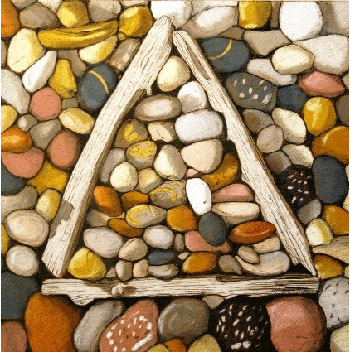
When you look at the color pencil art of Richard Klekociuk, you can almost feel the texture of the landscape and inhale the Tasmanian air. His coloured pencil art breathes with the commanding presence of his unique style and original imagery. Stones, rivers and deserts come alive in his colored pencil drawings with a startling realness.
Richard's colored pencil drawings are as richly-colored and luminous as paintings. His colored pencil artwork mainly focuses on landscapes - both real and symbolic.His strong compositions explore elements of realism, at times combining Christian iconography with Aboriginal stylistic qualities.
Richard Klekociuk is an artist from Tasmania, Australia. He has been an artist for over 33 years. A dedicated coloured pencil artist, he was kind enough to grant Art is fun an insightful interview about his color pencil art and his technique.

Is drawing your preferred art form and if so, why?

I have always preferred drawing since I was a child. I like its directness, ease of application and the fact that it causes little mess!
In the past 10 years I have taken a more serious approach and have tried to lift the profile (and value) of coloured pencil drawing in Tasmania.
What do you like best about working in coloured pencils?
I like the speed of working with coloured pencils and their huge colour range.
Is there anything that you don't like about working in coloured pencils?
There are times when detailed drawings can be quite tedious and I hate it when they break!

Do you have a favourite brand of coloured pencils?
Prismacolors are my preferred pencils, closely followed by Polychromos.
Do you have a favourite brand of drawing paper?
Canson Pastel Board is the best surface for my type of drawing.
How long (on average) does it take you to complete a drawing?
It depends on the size and detail. I usually like to work on 2/3 drawings over a period of a month.

Can you explain how you go about creating your coloured pencil artworks, from start to finish?
I don’t usually work topic-by-topic, preferring a thematic approach. I do an extensive amount of research when I get an idea, which I record in my visual diary and often mention on my daily blog. Because a lot of my work relates to the Tasmanian landscape, I “head out” and spend time photographing scenes and collecting objects, which are then used in a “still-life situation” in my backyard where they are photographed. I download my images onto my iMac and select and manipulate the most appropriate images, which I then print and display on a large noticeboard in my studio. From there I select what I want, grid up the image/s and draw them onto pastelboard.
I usually end up with a series of 3 or more drawings that are related, but certainly not looking the same.
Can you explain the symbolism of the bread and sandwiches that appear in your art?
There is often a strong Christian, symbolic element running through my work. In my ‘Bread’ series, I have looked at the relationship of bread to the landscape (its origin, texture, shape) and bread as the ‘staff of life’ in Christian worship. I have used humour as well as a more serious approach in some of this work.

There is still a lot for me to accomplish with this theme, but I am presently taking a new direction with an enamel mug! How can you relate a mug to the landscape I hear you say! Easy, I found a mug on a farm a few months ago (check out my blog) which was rusty, scratched, half-filled with dirt and full of character that (to me) truly reflected farm life. I am presently on my third, and most challenging drawing.
This has opened the door to new ideas, which I intend to explore at a later date.
I love how some of your landscapes are realistically rendered and how others are symbolist landscapes. What is it about the land or landscapes that inspires you to create these works?
I suppose for me, living on such a truly beautiful island that is under threat from exploitation and development, our diverse landscape offers so much subject material for me to express my love for God’s creation and my personal reaction to what is going on.
I often use landscape objects as symbols. Trees (particularly dead ones) often appear in my work as do tree stumps. Patterns from rocks hold much fascination for me, and feature strongly in my abstract work. Water, particularly moving, is also a favourite of mine.
Do you have any tips or advice for people who want to learn more about working in coloured pencil?
It is really important to experiment with as many brands of pencils and as many surfaces as you can. Find what suits your personal style and subject matter. Not all coloured pencils are the same! If possible, join a coloured pencil art class, read books, jump on the Internet and watch demonstrations. Visit artists’ websites and blogs.

A giant Thank You to Richard for such an insightful interview about his color pencil art! Be sure to check out his blog where you can learn more about Richard and see more examples of his stunning color pencil art. You can also purchase prints and t-shirts with Richard's beautiful art at his Redbubble shop.
Click here to learn how to create your own color pencil art!