The eye-catching narrative art of Paul Richmond
Paul Richmond's narrative art illuminates his journey of self-discovery as he explores questions of identity, gender and sexuality. Rich in color and innovative in composition, Paul's paintings weave together his personal narrative in images and symbols that welcome the viewer into his world. His paintings are accessible and charming, grappling serious issues while allowing viewers access to his struggles, desires, and insights.

Elegant Imbalance, by Paul Richmond
Working in both oils and acrylics, Paul often superimposes complex layers of imagery while playing with translucency, creating an imaginative multi-layered experience for his audience. His unexpected juxtapositions are at times whimsical and at other times, introspective. The human figure features prominently in his work, providing an instant human connection that draws us into the stories he tells through paint.

Born That Way, by Paul Richmond
Paul, who hails from Columbus, Ohio, was kind enough to provide Art is Fun with this fascinating interview that opens a window into his art and his working process.
How long have you been an artist? (Similarly, when did you know you wanted to be an artist?)
At the age of three, my favorite pastime was sitting at the dining room table with a stack of scrap paper and crayons, illustrating my imagined adventures as a fairy tale princess. Since becoming an actual princess wasn’t a viable career option, my parents chose to support my artistic interests by finding a local artist to take me under her wing. The day I stepped into Linda Regula’s studio for the first time, I knew exactly what I wanted to be when I grew up. And thanks to her thoughtful mentorship and the generous encouragement of my family, teachers, and friends along the way, that’s exactly what happened.
Where do you get your ideas & inspiration for your paintings?
Many of my paintings are inspired by my own personal experiences. After coming out of the closet, I used my art to explore that journey of self-discovery in a very personal series called “Ins and Outs.” Other inspirations include contemporary illustration and graphic design, classic pin-up art, fashion photography, vintage sideshow banners, and anything else pretty, weird, or sparkly that happens to cross my path. Usually the best ideas come when I’m not seeking them out at all.
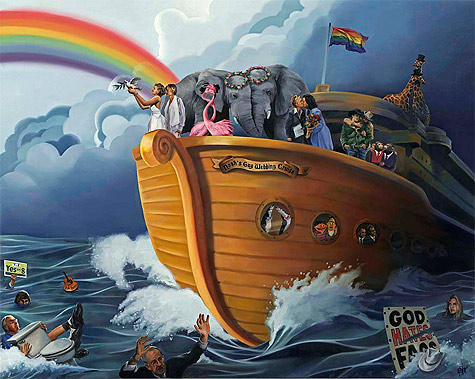
Noah's Gay Wedding Cruise, by Paul Richmond

close-up of Noah's Gay Wedding Cruise, by Paul Richmond
What do you hope to convey with your art?
I’ve always been drawn to illustrative art and I primarily see myself as a storyteller. I want my work to convey a definite narrative, whether it’s derived from personal experience or something more universal. My recent work explores themes of sexuality and identity - documenting my journey coming out of the closet and overcoming the repression of a Midwestern upbringing. I like challenging preconceived notions about gender roles, and my recent “Cheesecake” series tackles this topic with a wink and a nod to classic pin-up girls (by replacing them with contemporary gay male celebrities!). Ultimately, my biggest hope is that by being genuine, I can convey something about myself and my journey that will connect with viewers on a basic human level and help break down walls, stereotypes, and labels.
What do you enjoy the most about making art?

Contemplating his Dharma,
by Paul Richmond
The thing I enjoy most about the artistic process is its unpredictability. In most fields, if someone had been practicing for twenty six years, they would probably feel that they had achieved some level of mastery. That’s not to say I haven’t sharpened my skills over the years, but every time I step in front of my easel, I feel like it’s the first time all over again. There’s still so much to learn and it’s exciting. I can remember heading into Linda’s studio each week as a child and being filled with a sense of awe at the infinite possibilities. Walking into my studio today gives me the same feeling, and I can’t imagine ever getting bored with this career.
Can you describe how you create your paintings, from start to finish?
I usually play around with concepts by doing rough sketches on paper or digitally using Photoshop. Once I’ve worked out the composition, taken reference photos, and have a reasonable idea of the color scheme, I transfer the drawing to canvas and begin painting. Art school taught me that I should cover the whole canvas before narrowing in on details, and I tried that for a while, but I have since reverted back to my own preferred method of starting with the focal point, usually a face. Once the figure in my painting can look back at me, then I feel more connected to the work and branch out from there.
An overview of Paul's painting process:
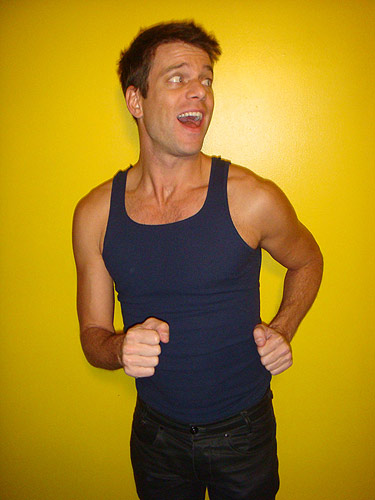
Reference photo for painting

Preliminary sketch for painting
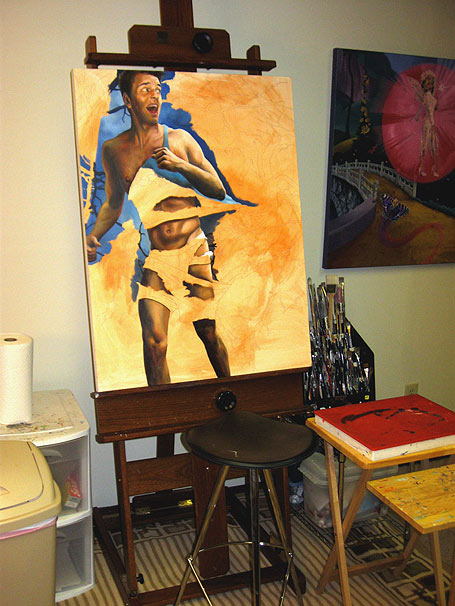
Work in progress

Finished painting, titled: In Hot Pursuit, Starring Jesse Archer - by Paul Richmond
How do you go about getting reference photos for your figurative work (Do you ask friends to pose, hire models, etc.)?

First Time Out, by Paul Richmond
Depending on the subject, I usually ask my partner, Dennis, or friends to pose. Sometimes, especially with the pin-up series, Dennis feels a bit too dignified for the wacky concepts that cross my mind! Try asking your cute Jewish partner to pose like he’s hanging an ornament on the Christmas tree while his pants fall around his ankles revealing mistletoe-patterned underwear! Fortunately, my recent “Cheesecake” series depicted gay celebs like Perez Hilton, Jesse Archer, and Mike Ruiz, and they were all too willing to drop their drawers for the sake of art! And if all else fails, I have no problem using the self-timer and posing myself. Just don’t expect to see those pics any time soon!
Who are some of the artists that you admire, and why?
One of my favorite pop artists is James Rosenquist. I love the way he is able to take ordinary objects and make them so monumental and abstract. I’m also inspired by a lot of artists from the Pop Surrealism movement, including Isabel Samaras, Mark Ryden, Joe Sorren, Todd Schorr, Eric Fortune, and my friend Melissa Forman. I also love photographer David LaChapelle, and gay artists such as Paul Cadmus, Gilbert & George, Michael Breyette, Robert Sherer, John Douglas, Ross Watson, and Jason Driskill.
Do you have any tips for aspiring artists?
First, I would suggest getting a copy of the book “How to Survive and Prosper as an Artist: Selling Yourself Without Selling Your Soul” by Caroll Michels (Amazon affiliate link). She does a great job of dispelling the myth that you can't make a decent living as an artist. Also, I would encourage other artists to keep an open mind about less-traditional opportunities to promote their work.

Remembering Tammy Faye, by Paul Richmond
As a gay artist with narrative oil paintings, marketing them presented an interesting challenge. Galleries that are looking for sofa-matching color schemes aren't beating down my door, nor are the highly conceptual or minimalist-oriented curators, but I've been really fortunate to find my own path. There was the Tammy Faye Memorial Celebration for one (you probably won't find that listed in any "How to Be an Artist" manual). Thanks to a portrait I painted of the late televangelist, my partner and I were invited to the private function along with guests Larry King, Cloris Leachman, and Ron Jeremy. Presenting my painting there led to exhibit opportunities with World of Wonder, a production company and art gallery in LA that had produced "The Eyes of Tammy Faye" documentary. Others started to take notice as a result, and along with a big boost from Internet exposure, the old "one-thing-leads-to-another" plan took off.

Many thanks to Paul Richmond for this articulate and insightful interview about his eye-catching narrative art! You can see more of Paul's narrative art at his website, www.paulrichmondstudio.com. Original paintings, prints, cards, books and other items featuring Paul's eye-catching narrative art can be purchased online there.
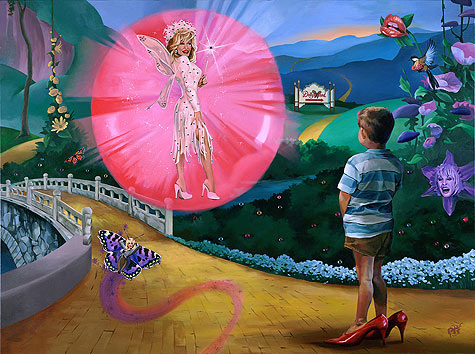
The Dollypop Guild, by Paul Richmond