Pen and Ink Drawings
Aside from pencil, pen and ink drawings are probably the most portable, convenient, and low-cost form of artmaking. All you need is a pen and a piece of paper, and you're ready to make art!
Nearly everyone has doodled with a pen in the margins of their paper. Drawing with pens can be as fun and easy as that!
There are many types of pens available for drawing, such as:
fountain pens
graphic pens
drafting pens
reed pens
and even ball point pens.
Any of these types of pens can be used to create fine art!
pens
Each type of pen will result in a different quality of line. The kind of pen you prefer will depend on the type of line you would like to create, bearing in mind such qualities as thickness or thinness of the line, and fluidity versus control. The kind of pen you choose will also depend upon the type of art you want to create, in terms of style and subject.
I've provided links below to the relevant products so that you can easily find them on Blick Art Materials, my favorite online art supplier. I'm a member of Blick's affiliate program, which means if you make a purchase after clicking on one of these links, I'll receive a small commission (at no extra cost to you). Your purchase helps support this site and keeps it free of ads. Click here for more info.
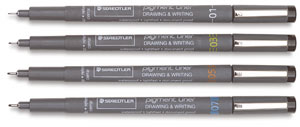
My four favorite pens are currently the Prismacolor Premier Illustration Markers, Sakura Pigma Micron Pens, Staedtler Pigment Liner Pens, and Spectrum Noir Artliner Pens. These are the pens that I use to create my ink drawings. They come in a variety of nib thicknesses. I especially love the super tiny nibs (.005), because they allow for lots of detail. However, it is really handy having the thicker ones for filling in lots of space! Therefore, I would recommend having a range of nib sizes.
If you are using only one color ink on paper, you'll basically be working in two colors: the color of your ink, and the color of your paper. Each will play off the other. In pen and ink drawings, the blank space is just as important as the markings you make with the pen. Therefore, you need to pay as much attention to what's going on in the background as you are to what you're doing with the pen. If you are more accustomed to working in color, this will require a different way of thinking and creating art than you might be used to.
paper
If you make a purchase via the links below I receive a small commission, which helps support this site.
There are many different types of art paper that you can use for your pen and ink drawings. In addition to the many varieties of drawing paper on the market, you can also use papers that are designed for painting as well as drawing. For instance, watercolor paper is great for pen and ink drawings, especially if you plan to do watercolor washes under or over the ink drawing. Printmaking papers, illustration board and bristol board also work well.
Some interesting papers you may want to experiment with are: Yupo, vellum, colored paper, metallic paper, papyrus, Nepalese Lokta papers, Japanese paper and/or handmade paper.
Feel free to think outside the box. If you're not concerned about longevity, you can create art on a variety of unconventional surfaces, such as the inside of a cereal box, cash register receipts, vintage book pages or postcards, etc. Traditionally, these types of surfaces were not recommended for making "fine art" - one reason being the high acidity levels of these papers, which means the paper would yellow and deteriorate over time. These days, anything goes in contemporary art, so these issues are less of a concern. However, if you do want to take the extra step to ensure longevity, there are archival sprays on the market that can neutralize the acidity in such papers.
other materials
So you've got your paper and pen. What else might come in handy for your ink drawings? There are a few other materials that you might consider keeping on hand whilst working on your pen and ink drawing:
To help fund this site, I receive a small commission from purchases made via the links below.
- pencil - Ink is a very unforgiving medium. Once you make a mistake, the best you can do is try to cover it up by integrating the mistake into the drawing. Worst case scenario, you'll need to start over. That's why a pencil is handy for lightly sketching in your initial drawing.
- kneaded rubber - If you've sketched in your drawing with pencil first, you'll need to erase it after you've applied the ink. I would recommend using a kneaded rubber, because you can mold it to the shape you need and it won't leave any 'flakes' like some erasers do.
- ruler - If you want to make straight lines, rulers are essential.
- templates - If you want to make perfect circles, ovals, or other shapes, you don't need to torture yourself by trying to draw them perfectly freehand. Use a template!
- archival sealant spray - After you're drawing is finished, it's a good idea to give it a coating of archival spray. This will seal in the inks, ensuring that they are waterproof. A good spray will help to protect your drawing.
Read More
There are many different drawing papers available for creating pen and ink artwork. Learn about several different kinds of art paper that you can use to make your pen and ink drawings!
Learn about the best drawing pens for fine artists. Find out why you should use archival pens if you want your pen and ink art to last a long time!
Check out these Frequently Asked Questions (and answers!) from readers interested in pen and ink artwork.

How to create value in pen and ink drawings
Most people are somewhat familiar with the process of shading with a pencil, but not everyone knows how to do it with a pen. Learn the basic techniques for creating value in pen and ink drawings.
Check out the detailed pen & ink drawings of Eli Helman. In this exclusive interview, he discusses the process and inspiration behind his elaborate pen and ink art.
View the realistic pen and ink artwork of Sue Pownall, created on site as she travels the world!
Victim of accidental ink spillage? Learn how to remove ink stains!
Frequently Asked Questions
Got a question about working in pen and ink? This handy FAQ about pen and ink techniques contains questions and answers from pen and ink artists like you.