Portrait Painting and Drawing
A portrait painting or drawing depicts the image of a particular person or animal, or group thereof. The subject of a portrait is usually called a "sitter", because traditionally people would sit in front of the artist to have their portrait painted. Nowadays, of course, artists can work from a photograph, so not everyone has to "sit" for a portrait.
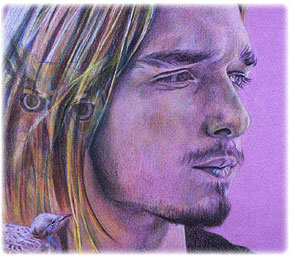
Portraits are effective and compelling when they tell us something about the person. A good portrait is not just a visual representation of a person; it will also reveal something about the essence of the person. What the portrait reveals may not be completely obvious - sometimes it can be cleverly implied through a certain expression or pose, an included object, or the artist's use of color. Sometimes the person in the portrait can become iconic, representing a wider group of people from a specific period in time, who share something in common.
A strong portrait captivates viewers, draws them into the painting, and engages their attention. Such a portrait painting causes the viewer to wonder about the person depicted. In this way a portrait painting or drawing can function as a biography - telling the story of that person's life. The artist will carefully craft visual clues to tell the story of the person in the artwork. Portrait paintings can reveal the sitter's place in society, their hobbies or occupation, or aspects of their personality or beliefs. When looking at a portrait painting, ask yourself:
What do the details in this artwork tell me about this person's life?
Examine things like:
Facial expression - Does the sitter look happy, sad, contemplative, sarcastic? Lively or tired? Peaceful or angry? Friendly or menacing?
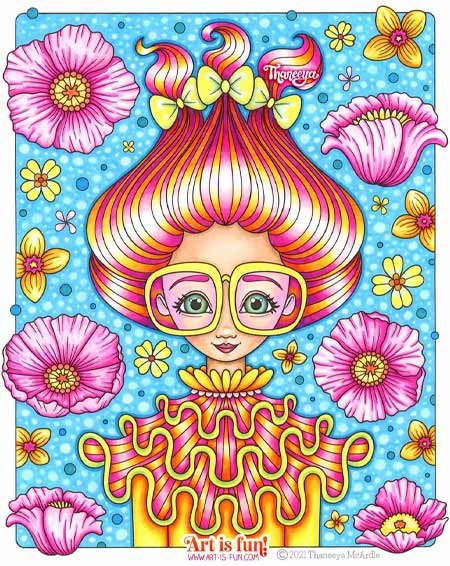
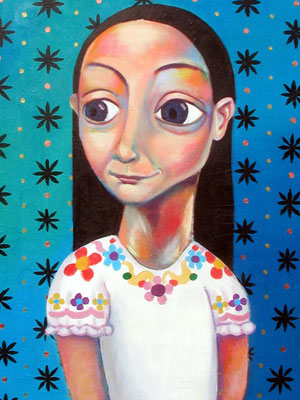
Learn to color in this whimsical portrait using alcohol markers in my step-by-step coloring lesson!
Gesture or pose - What is the sitter doing? Are they sitting still, or standing? Are they riding a horse? Are they gazing out to sea? Holding a basket of flowers? Are they pointing at something?
Clothing - How is the person dressed? Are they nude? If they are clothed, do they wear fancy clothes? Military regalia? A black evening gown? Or are they more modestly dressed? Are they wearing tattered clothes? Are the fashions contemporary or old?
Setting - Where does the portrait take place? Is it indoors or outdoors? What do the surroundings look like? Shabby or elegant? Modern or dated? Is it in someone's kitchen? Or on top of a mountain?
Objects - What other objects are in the painting, besides the sitter? If they are sitting down, what kind of chair is it - a fancy ornate chair, soft velvet sofa, or a plain wooden chair? Are they holding anything? Are there objects in the painting that grab your attention?

Styles of Portrait Painting
As you can see, portrait paintings can tell us a lot about the person, people, or animal(s) that are depicted in the artwork. The way that the artist handles the medium will also tell us a lot about the intention behind the work. For instance, portrait painters can use any style they choose to create their artwork, each having a different effect on the overall tone of the piece.
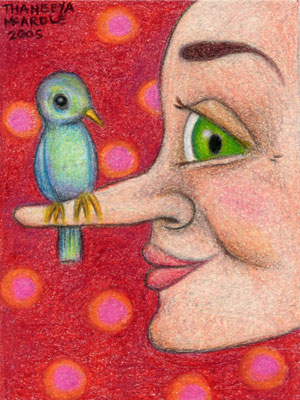
Below I've collected a few possibilities of how an artist can handle their paints and pencils when creating a portrait painting. (All of this artwork was done by me.) If you want to paint a portrait, but you're not sure where to begin, consider all of these possibilities about how a portrait can look. Compare and contrast the portrait on the left with the one on the right, noting how the different techniques determine the portrait's overall appearance.
Portraits can be realistic...
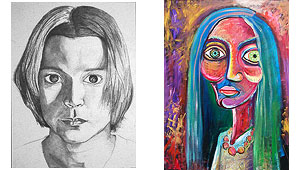
...or expressionistic
Or they can be a multitude of other styles. The point is, they don't all have to look realistic. The style an artist chooses will alter the effect the portrait has on the viewer. Fauvist, Dada, and Cubist portraits will all look very different and each will portray a different meaning.
They can use normal skin colors...
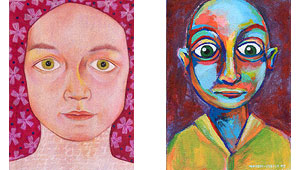
...or unconventional color schemes
Strange or surprising color schemes can be used to great effect in portrait painting. It's an excellent way to convey emotion. For further examples, see Picasso's portraits painted during his Blue Period, or these self-portraits by Van Gogh.
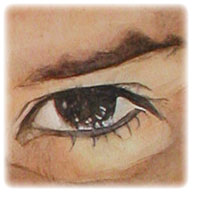
Features can be detailed and delicate...
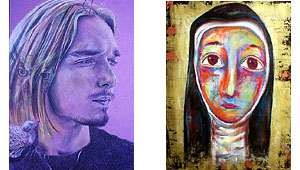
...or created with rough brush strokes
Another effective way to convey emotion in portrait painting is through the brushstroke. Delicate, detailed portraits often carry a certain sensitivity and thoughtfulness. An artist using rough, choppy brushstrokes approaches portrait painting from a different, more expressive angle. View this portrait painting by Willem de Kooning for an example of an Abstract Expressionist portrait painting that utilizes these types of brushstrokes.
The artwork may show just a face...
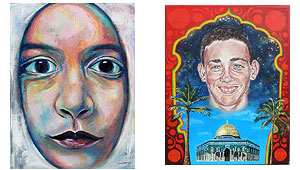
...or include different objects and features
Objects included in the painting provide visual clues about the person depicted. While the face is often still the focal point, the inclusion of other objects can often add interesting elements to the artwork. Paintings that show just the person's face or body demand that the viewer's entire concentration focus on the person depicted.
The face can be three-dimensional...
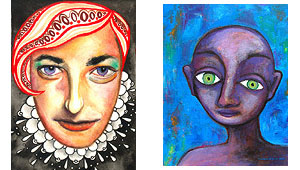
...or the features can be flat
The portrait can seek to replicate reality by making the figure look sculptural, as if it really existed in 3-dimensional space. Or the artist may play with the 2-dimensionality of the flat surface, and render a portrait that doesn't seek to emerge from the picture plane.
The art might cover the surface...
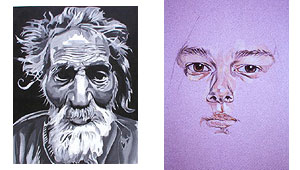
...or remain unfinished
Most people probably think of finished portrait paintings as being entirely covered with paint, all the way to the edges. But they don't have to be! Often, leaving large amounts of the artwork "blank" can create some very intriguing portrait compositions. It's a matter of suggesting what is there, rather than showing what is there. Implying, rather than telling.
Each of these choices will effect the way that the portrait is perceived by the viewer. These are just a few examples of choices that artists make when composing a portrait. There are many, many more! For instance...
Composition, pose and size
For starters, portraits can show the full figure of the person, or just the head, or any combination in between. A portrait can even focus on a specific part or region of the person's body, cropping out the rest. A great example is this colored pencil drawing by Alan Magee, which shows a beautifully detailed portion of a woman's braid, with the rest of her profile fading into a ghostly silhouette. Another example is this fun and easy Henna Hand Designs Art Project, which shows you how to make a unique self-portrait featuring your hands!
The pose is also important. The person can be facing straight ahead, depicted in 1/4 turn, captured in profile, or be turned 3/4. There have even been portraits showing just the back of a person, such as Andrew Wyeth's painting, Christina's World. Another example of an unconventional pose for a portrait is Gerhard Richter's painting of his daughter, Betty, in which she is turned away from the viewer.
front view
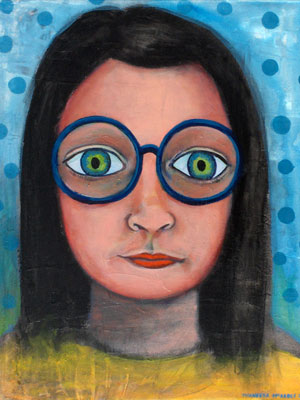
1/4 turn
profile
Lastly, the size of a portrait painting is also worth mentioning. From the 16th - 18th century in Europe, the art of portrait miniatures in gouache or watercolor were all the rage. Before the invention of photography, miniature portrait paintings served a similar function as photos do today. These tiny artworks would sometimes be as small as 30cm x 40cm.
On the other hand, portraits can also be huge. An extreme example is the 2.5 acre portrait of Barack Obama by Cuban-American artist, Jorge Rodriguez-Gerada. The temporary portrait is made of sand and gravel, and lies on a Barcelona beachfront. The exact size of the portrait is 445 feet by 264 feet (139.28 by 82.67 meters).
Most portraits fall somewhere in between these two extremes!

Painting the truth or changing reality?
An artist might choose to depict a person exactly as they are - flaws included, so that every wart, pimple or scar is clearly memorialized in paint for all to see. Artists may sometimes even exaggerate a person's characteristics, good or bad, to make a caricature of the person. Conversely, an artist might "kindly overlook" the person's flaws, correcting imperfections and presenting an idealized view of a person. It all depends on what the artist wants to achieve with the work, and also what they plan to do with it. For instance, a private collector who is commissioning a special portrait might prefer to have their flaws 'removed', rather than imprinted in pigment for posterity.
A great example of an artist who is not afraid to paint people with less-than-perfect bodies is Jenny Saville, who paints huge portraits of overweight people from various angles. She handles the paint in such a way that her paintings look as hefty and weighty as the subjects she depicts.
Another artist who paints people as they are, pretty or not, is Lucien Freud. Says Freud, "I paint people not because of what they are like, not exactly in spite of what they are like, but how they happen to be". Not too long ago he landed himself in hot water amongst the British public for his painting of the Queen. Many people criticized Freud for painting an "ugly" portrait of the Queen, rather than a flattering one. Perhaps they didn't realize that Freud paints everyone, even himself, in this same honest but unforgiving manner. It is true that historically, portraits of monarchs and royalty were always painted in reverential, elevated tones. But in these modern times, we see leaders and figureheads as humans instead of gods. As such, Freud's painting depicts the Queen as human, as opposed to divine. Additionally, there is one further point as to why Freud was about to "get away" with painting the portrait in this manner: this particular portrait was not commissioned or paid for by the Queen, so as the artist, Lucien Freud held the power and freedom to execute the painting as he wished.

Hopefully this page has given you a lot to think about when composing your own portrait paintings, and deepens your understanding of what to look for when viewing portrait art. Now that you have all of this information, the best thing to do is look at lots of art! If you get the chance, here are two noteworthy art museums that are solely dedicated to the art of portraiture:
Smithsonian National Portrait Gallery - Washington, DC
National Portrait Gallery - London

Oil Portraits of Mike Ivey

Check out the oil painting portraits of Mike Ivey! Mike is a self-taught artist specializing in portrait paintings and drawings. He works in oil paints, colored pencils, graphite and chalk.
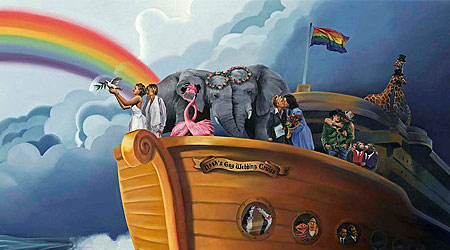
Paintings of Paul Richmond
Check out the oil painting portraits of Mike Ivey! Mike is a self-taught artist specializing in portrait paintings and drawings. He works in oil paints, colored pencils, graphite and chalk.
Printable Coloring Pages
If you’re into coloring, check out my set of printable Enchanted Faces Coloring Pages! This set of 10 coloring pages features a variety of whimsical portrait illustrations for you to bring to life with color.

If you make a purchase via the links below I receive a small commission, which helps support this site.